Point 18 — Quadrilaterals
Parallelograms, rhombuses, trapeziums, kites, and regular polygons.
Parallelogram: diagonals bisect each other. A parallelogram inscribed in a circle is always a rectangle.
Rhombus: all sides equal, opposite sides parallel, opposite angles equal. Diagonals bisect each other at right angles but are not equal. Area = d1d2. The bisectors of the four angles enclose a rectangle.
Trapezium: the median is half the sum of the parallel sides, EF = (AB + CD). A trapezium inscribed in a circle is isosceles.
Kite: two pairs of adjacent congruent sides; the diagonals intersect at right angles.
Regular polygons: the sum of all interior angles = (n − 2) × 180°.
Question 1 of 2
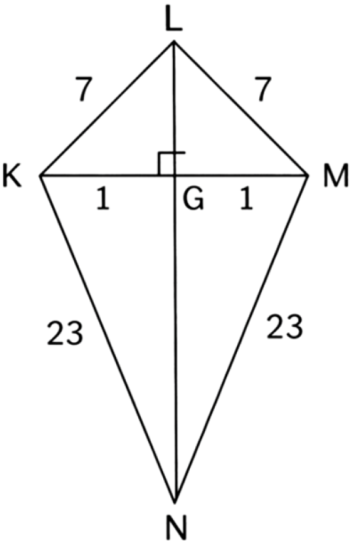
In quadrilateral KLMN (shown in the figure below), KL = 7, LM = 7, KN = 23, and MN = 23. Diagonals KM and LN (not shown) intersect at point G (not shown), where GK = 1 and GM = 1. If the length of diagonal LN is + , where p and u are integers, what is the value of p + u?